Dental implants
The durable answer to a missing tooth. A titanium post takes over the role of the root, and the crown is fixed on top of it — the part you see and chew with.
- Implant from
- 650 EUR
- Total time
- 3–6 months
- Age limit
- none
What it actually is
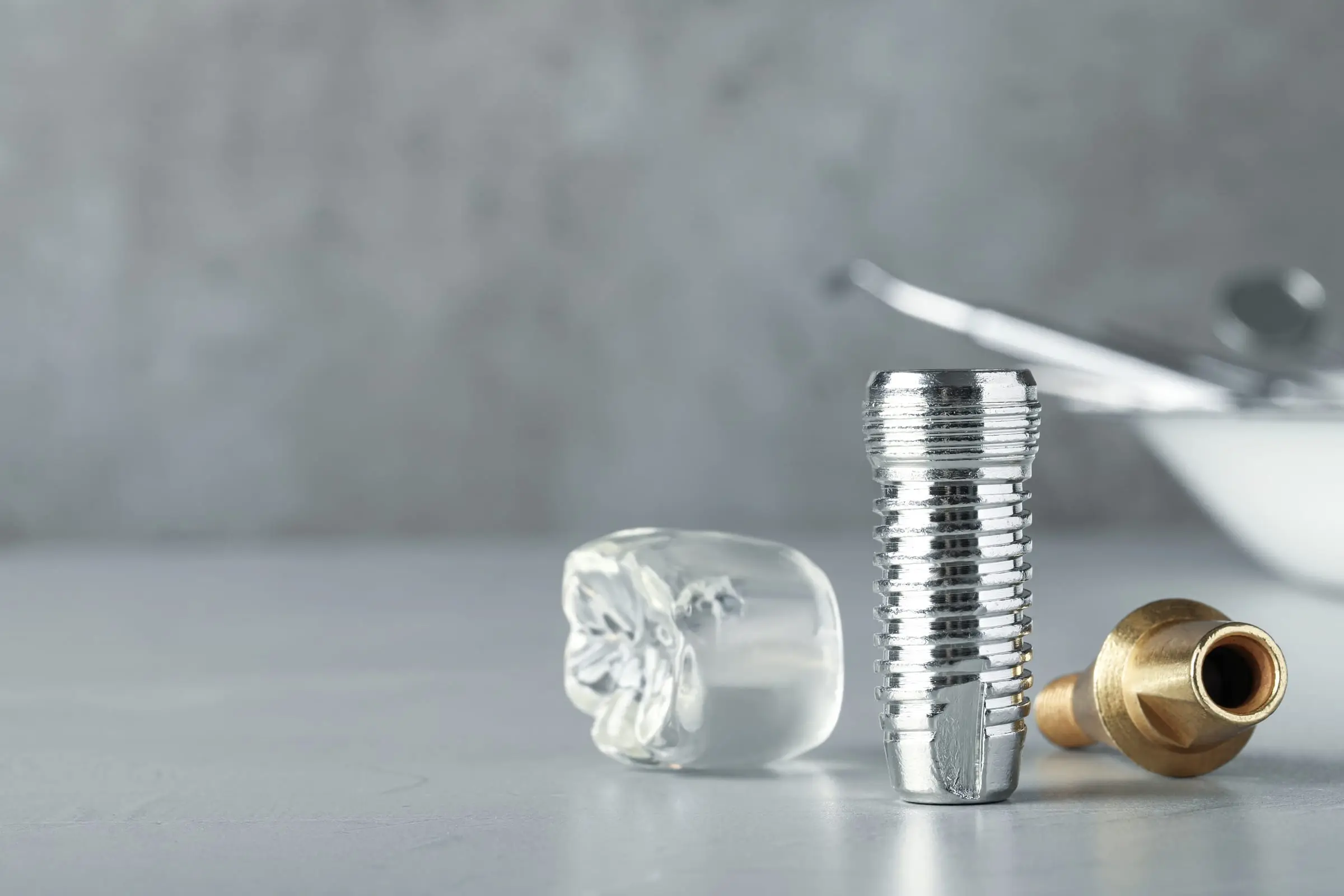
A dental implant is a titanium post placed in the jawbone. It does not replace the whole tooth, it replaces the root. An abutment attaches to the implant, and the crown — the visible part — attaches to that.
Titanium is used because bone grows onto its surface and locks it in place. That process is called osseointegration, and it is why months pass between placement and crown: we are not waiting for soreness to pass, we are waiting for bone to take hold.
Why an implant rather than a bridge
A conventional bridge rests on the neighbouring teeth, which have to be ground down to take the crowns. That is two healthy teeth losing substance to replace one.
The second reason is bone. Under a missing tooth the bone is no longer loaded and resorbs — over years the cheek visibly changes shape in that area. An implant loads it much as a real root would, so the bone stays.
A bridge is quicker and, in the short term, cheaper. The difference shows at ten years, not at two.
Who it suits
There is no age limit. Three things matter: how much bone there is and its quality, the health of the gums, and general conditions — diabetes, bisphosphonate treatment, smoking.
All three are assessed individually at the consultation, with an X-ray. Nobody can tell you over the phone whether you are a candidate.
Insufficient bone does not mean "not possible". It means grafting or a sinus lift comes first and the implant follows. That adds time and cost, but it remains a route.
How it goes
- 01
Consultation and X-ray
day 1The available bone is measured and we establish whether grafting is needed. You learn the plan and the total cost here, not at the end.
- 02
Placing the implant
one appointmentUnder local anaesthetic. About an hour for a single implant. You go home the same day.
- 03
Osseointegration
3–6 monthsBone grows around the implant. Throughout, you wear a temporary solution if the area is visible.
- 04
Abutment and crown
2–3 visitsThe implant is exposed, an impression is taken, and the final crown is fitted, matched in shape and shade to your own teeth.
What it costs
The prices below are for separate stages. A typical case means implant + abutment + crown, not just the first line — which is why the full plan is discussed at the consultation, with the total.
- MIS implant
- 650 EUR
- Straumann implant
- 1100 EUR
- Implant abutment
- from 100 EUR
- Crown on implant
- from 1500 lei
- Implant exposure
- 50 EUR
- Sinus liftwhen there is not enough bone in the upper jaw
- from 1500 EUR
- Bone graft with non-resorbable membrane
- from 2000 EUR
- Khoury techniquebone reconstruction using your own bone
- from 1300 EUR
Common questions
How long from start to final crown?
Three to six months in ordinary cases. Most of that time nothing is being done — we are waiting for bone to integrate the implant. If grafting is needed first, add another four to six months.
Does it hurt?
Placement is done under local anaesthetic and is not felt. Afterwards the discomfort is comparable to a simple extraction and is managed with ordinary anti-inflammatories, generally for two or three days.
What is the difference between the MIS and Straumann implants?
Straumann is a Swiss system with a longer clinical record and more extensive documentation, at close to double the price. MIS is Israeli and widely used. Which one suits depends on the case and the budget, and is discussed at the consultation — we work with both routinely.
How long does an implant last?
The implant itself, once the bone has integrated it and with good hygiene, can last a lifetime. The crown on top is a wearing part and may be replaced after ten to fifteen years, like any prosthetic work.
Can I have an implant if I smoke?
Yes, but smoking raises the risk that the implant does not integrate and that the surrounding gum becomes inflamed. It is not an absolute contraindication; it is a factor we account for in planning and talk about openly.
The plan and the cost are settled at the consultation.
With an X-ray and an assessment of the bone, not over the phone. You learn the total before anything starts.